Clovercreek Municipal Utility District
Through Clovercreek MUD’s website you can easily find links to the following services:

Through Clovercreek MUD’s website you can easily find links to the following services:
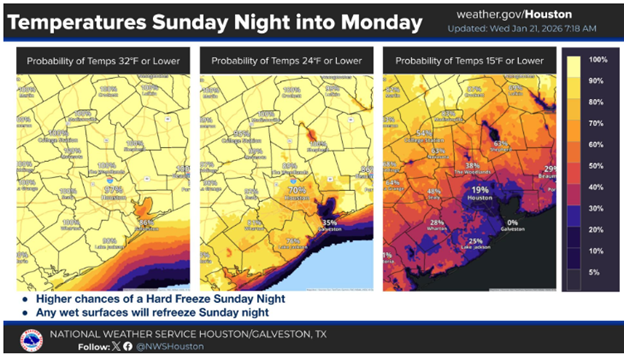
Clovercreek MUD would like to advise residents of potential winter weather and cold conditions coming Saturday evening (1/24) and continuing to Monday evening (1/26) as the forecasted cold front moves into our area in the latter part of the week. While meteorologists are still uncertain regarding how cold it will get, there is the potential for a hard freeze in all non-costal locations.
A hard freeze is a temperature under 30° for over eight hours. When water freezes, it expands. When the freeze ends, the result can be broken pipes, no water, a big repair bill and the cost for the lost water. Those are not the only expenses and source of aggravation. You may also have to replace carpet, flooring, sheetrock, furniture, and other possessions. Those are the immediate issues, but there can be latent damage as well. With galvanized pipe, the pipe may not burst, but expansion can occur separating the galvanizing from the pipe and creating an area for corrosion to start and ultimately create leaks.
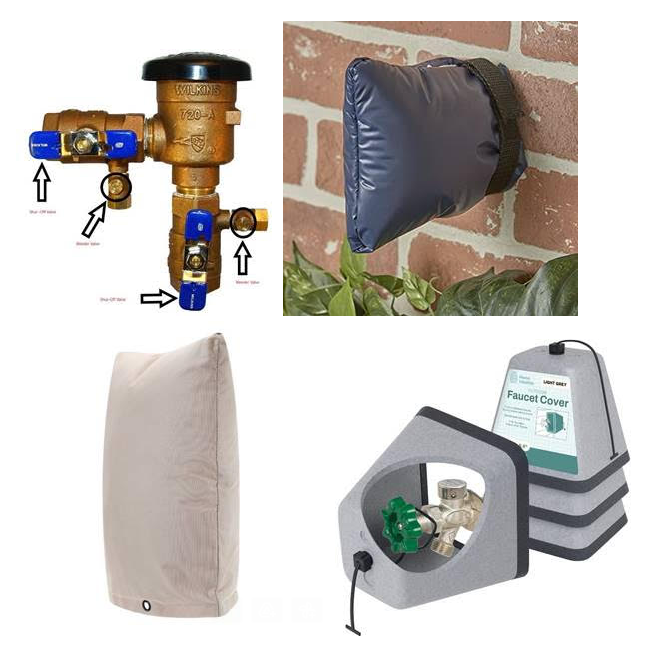
During Winter Storm Uri, one of the more vulnerable spots for leaks and bursts were the irrigation systems on residential homes. Below are some basic tips as well as pictures and instructions for irrigation backflow preventors; additionally, residents are always encouraged to consult with a irrigation specialist or plumber.
The irrigation shut off valves and backflow device are one of the common issues that most residents deal with during an extended freeze.
Attached are pictures of the actual device and insulation covers for backflow devices and faucets.
As stated above, with temperatures expected to drop below freezing, it is a good time to refresh on the four P’s: People, Pets, Pipes, and Plants.
Additionally, there are a few vehicle-safety tips to observe during winter weather:
Lastly, here are some safety tips recommended by local Fire Departments regarding space heaters and other supplemental heating sources:
Share these tips to neighborhood social media outlets; Facebook, Nextdoor, and Twitter shares can help neighbors see these tips before the weekend. Stay safe and warm!
A public hearing for Clover Creek Municipal Utility District to discuss the proposed tax rate for the 2025 tax year will be held on September 18, 2025 at 6:30 PM. The hearing will take place at Magnolia Community Center, 422 Melton Street, Magnolia, Texas 77354.
The start up of the remote water well was on Friday morning in Clovercreek MUD. The contractor, plant operator and I (and others) were there to witness the results of the start-up. Everything went well with the new motor and the electronic testing.
At this point, we are only waiting on passing Bac-T’s water test results. These should come in either tomorrow or Wednesday. Once we have good water tests, the well will be put into operation for the residents of Clovercreek. This is good news.
Neighbors,
There has been a change in the day that homeowner recycling will be picked up.
The new day will be on Thursdays effective September 2, 2024. Trash day will still be on Mondays.
Please ensure that you put your recycle bins on the edge of the street starting this day.
Thank you!
Message from GFL Environmental:
In the wake of the hurricane and the large amounts of debris left from it’s path, it would be impossible for us to provide normal collection and be able to service all residents in your area.
By prioritizing and ensuring that ALL regular household garbage is collected each day and this weekend, we are preventing unsanitary conditions from happening in our neighborhoods.
This means we have suspended bulk and recycle collection for the next week of July 15th. We appreciate your patience and understanding as we work to get back to normal.
Tomorrow, March 13th, the contractor will resume 24-hour operations starting in the evening. Test pumping is expected to be completed by evening of Saturday, March 16th .
Work continues on Clovercreek MUD’s new water well at the southeast corner of the intersection of Cloverleaf Drive and Forest Hill Drive. The contractor is currently ahead of schedule, and the well is expected to be completed by August 2024, instead of October.
The big drilling rig has been moved out and, with that, most of the 24-hour operations have been completed. A smaller well development rig has taken its place.
Well development is currently underway. Those activities will take place between 7:00 AM and 7:00 PM.
The next, and last, 24-hour operation is scheduled for a 4-day period in the middle of March. The current schedule is for 3/13/2024 to 3/17/2024, but the exact date depends on how quickly well development goes.
After that, work will return to standard 7 AM-to-7 PM operations. The sound walls will remain up throughout the project.
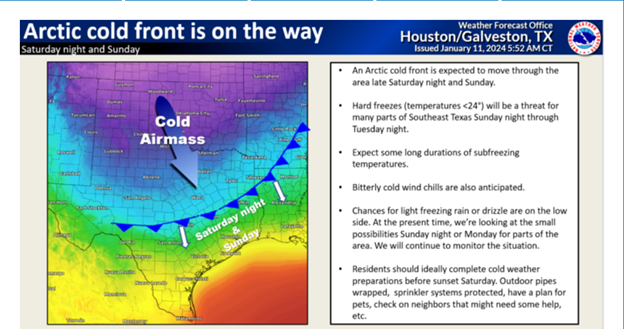
TNG Utility Corp. Would like to advise residents of potential winter weather and cold conditions coming Saturday evening (1/13) and continuing to Tuesday morning (1/16) as the forecasted cold front moves into our area. While meteorologists are still uncertain regarding how cold it will get, there is the potential for a hard freeze in all non-costal locations.
A hard freeze is a temperature under 30° for over eight hours. When water freezes, it expands. When the freeze ends, the result can be broken pipes, no water, a big repair bill and the cost for the lost water. Those are not the only expenses and source of aggravation. You may also have to replace carpet, flooring, sheetrock, furniture, and other possessions. Those are the immediate issues, but there can be latent damage as well. With galvanized pipe, the pipe may not burst, but expansion can occur separating the galvanizing from the pipe and creating an area for corrosion to start and ultimately create leaks.
Below are some basic tips as well as pictures and instructions for irrigation backflow preventors; additionally, residents are always encouraged to consult with an irrigation specialist or plumber.
The irrigation shut off valves and backflow device are one of the common issues that most residents deal with during an extended freeze.
Attached are pictures of the actual device and insulation covers for backflow devices and faucets.
As stated above, with temperatures expected to drop below freezing, it is a good time to refresh on the four P’s: People, Pets, Pipes, and Plants.
Clovercreek MUD is in the process of constructing a 250 gallon per minute Water Well at the South-East corner of the intersection of Cloverleaf Drive and Forest Hill Drive. Construction is expected to be completed by October of 2024.
Please note that some well development tasks require 24-hour tests. For that reason, we are planning on installing a sound wall around the perimeter of the site which will reduce the noise generated from such activities.
Currently the contractor is collecting water samples from the test hole. Water sampling is expected to be completed by the Friday before Christmas, 12/22/23. After that, the contractor will move off site for a month while we wait for lab results. Water well construction operations are expected to resume on 1/23/24.
By then, we will have a sound wall installed around the perimeter of the site. Please note that construction activities that do NOT require 24-hour testing are restricted to Monday thru Saturday, 7:00 A.M. to 7:00 P.M. We will provide another construction schedule update by end of January 2024.